

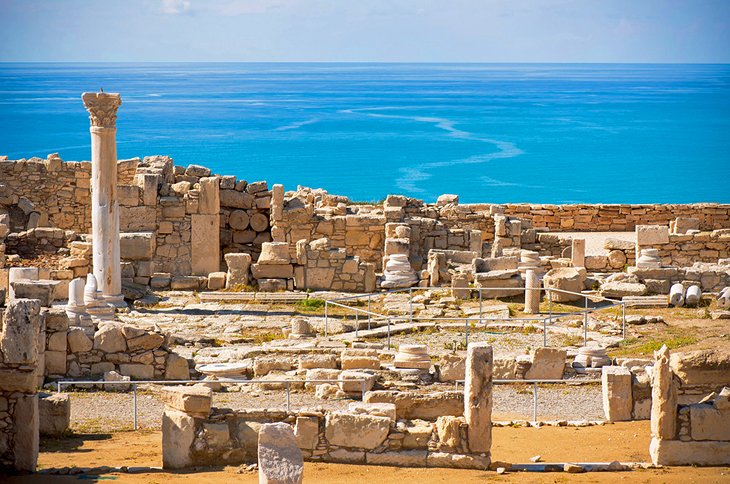
About This Location
Major Highlights Inside the Park:
- Odeon: A small Roman theater used for musical performances, gatherings, and entertainment. It demonstrates the cultural life of ancient Paphos.
- Agora: The ancient marketplace of Paphos, where merchants once sold goods, and locals gathered for social and commercial activities.
- House of Theseus: A Roman villa famous for its intricate mosaics depicting the mythical adventures of Theseus, including his battle with the Minotaur.
- House of Orpheus: Another Roman villa with mosaic floors illustrating the legend of Orpheus, showcasing the artistry and mythology of the period.
- Paphos Mosaics: Spread across several villas, these mosaics are the park’s centerpiece. Vibrant and well-preserved, they depict scenes from Greek mythology, including Dionysus, Theseus, and Orpheus.
- Asclepeion: The healing sanctuary dedicated to Asclepius, the god of medicine, highlighting the spiritual and medical practices of ancient Paphos.
- Early Christian Basilica: Remains of a Byzantine church, reflecting the city’s transition from pagan Roman to early Christian society.
- Paphos Lighthouse: Originally built in the 19th century, located near the harbor, providing scenic coastal views and a landmark for visitors.
Visitors can explore the ancient streets, villas, public buildings, and religious sites, all in one expansive area. Walking through the park provides a rich mix of history, art, and architecture, from the intricate mosaics of elite homes to civic spaces like the Agora and Odeon, as well as religious and healing sites. Its coastal location adds a scenic dimension, making it both an educational and visually stunning experience.
✨ Why It's Special
- Roman mosaics — intricate floor mosaics depicting Greek mythology, including the House of Dionysus and House of Theseus
- Ancient ruins — villas, fortresses, theaters, and early Christian basilicas
- UNESCO World Heritage Site — recognized for its cultural and historical significance
- Seaside location — situated near Paphos Harbour, offering a scenic setting for history lovers
- Educational and cultural experience — guided tours and informative displays bring the ancient city to life
Getting here by bus
- Paphos Harbour Stationabout 200 m awayOSYPA (Paphos)
606610611631
- Kato Paphosabout 500 m awayOSYPA (Paphos)
606610611631
- Ap. Pavlou Ave. - Kyriakou Nikolaouabout 500 m awayIntercity
36
- Ap. Pavlou Ave. - Kyriakou Nikolaouabout 500 m awayOSYPA (Paphos)
606610611631
Scheduled times in Cyprus local time, from the Cyprus National Access Point (CC BY 4.0). Timetables and routes can change — check with the operator before travelling.
🗺️ Other Sights Nearby
Paphos Castle
Paphos Castle stands proudly at the western end of Paphos Harbour, a sturdy sentinel overlooking the sea and town. Its origins go back to Byzantine times when it was built to protect the harbour. Over centuries the castle was rebuilt and modified: by the Lusignans, dismantled by the Venetians, and then restored by the Ottomans in 1592. Th
Aphrodite's Rock / Beach
Aphrodite’s Beach, also known as Petra tou Romiou (Rock of Aphrodite), is a legendary stretch of coastline on the south-west coast of Cyprus near Kouklia. The beach is famous not only for its beauty but also for its mythic heritage: according to ancient Greek myth, Aphrodite, the goddess of love and beauty, emerged from the sea foam at th
Petra tou Romiou
Petra tou Romiou, also known as the Rock of Aphrodite, is one of the most famous landmarks in Cyprus, located along the coastal road between Paphos and Limassol. The site is steeped in mythology, as it is believed to be the birthplace of Aphrodite, the goddess of love and beauty, who rose from the sea foam at this very spot. The dramatic